http://www.enkata.com/how-much-is-your-enterprise-wasting-on-repeat-calls/
Saturday, May 12, 2012
How Much is Your Enterprise Wasting on Repeat Customer Service and Sales Calls? - Enkata
http://www.enkata.com/how-much-is-your-enterprise-wasting-on-repeat-calls/
A Conversation On The Role Of Big Data In Marketing And Customer Service
In the following conversation, Verint's Daniel Ziv and Ovum analyst Keith Dawson share perspective on the sudden lure to the term "big data" and what it means for companies in the coming year.
1. Big data is a buzzword that seems to be making its way into conversations more frequently. How would you define big data, and how is this new business concept different from traditional business intelligence?
Keith: Big data is a buzzword partly because the definition of "big" changes all the time, as processing power improves and data storage capabilities grow vaster. However, it does have a real meaning, and is usually shorthanded by the four V's, which are as follows:
- Volume: the amount of data being worked with
- Variety: the number of different sources and data types
- Velocity: the speed at which it changes, which is very fast
- Value: the ability of an organization to process and leverage machine-derived insights
2. Is big data something IT departments need to manage and address? How does it have an impact on the marketing organization as well?
Keith: Big data starts with IT, most definitely, because they are responsible for acquiring and deploying the infrastructure. From a business point of view, marketing is poised to reap significant value out of big data. Look at the wealth of actionable knowledge inherent in CRM data, social media mining, or even basic customer call recording -- there is enormous potential not being realized with traditional analytics structures. This theory applies beyond the contact center and also to business intelligence and ERP systems, which are still trying to figure out how to put data from some of those external sources to work.
Daniel: I agree completely! We, as an industry, have witnessed some phenomenal examples regarding how much value this data can represent -- especially when driven effectively by the business including marketing departments. For example, I've seen a large telecom provider do this very thing. The company is BI savvy and has traditionally analyzed structured data. It added a speech analytics solution to help analyze contact center calls, and as a resultin the first year of deploymentthey identified $180 million worth of savings, while increasing customer satisfaction by 30%. What's even more interesting with this particular initiative is that it was driven mostly by marketing, not by the IT department where many big data deployments reside.
3. Do you believe that a company's corporate big data assets and its use of analytics could become something as powerful as the company's brand?
Keith: There are already companies for which the ability to analyze big data is functionally equivalent to their brand. Facebook is the obvious example, and Google too. Then you get beyond that to customer-facing companies like Netflix or Amazon, where their ability to determine patterns of customer preference and behavior stems from analysis of huge data sets. They are making business decisions on automated data analysis -- the kinds of things that used to be done with focus groups. The difference is that they are coming to much richer, statistically valid and more insightful conclusions.
Daniel: Facebook definitely has the potential to be a key data analytics force. The acquisition of Instagram brings yet another dimension of unstructured data to social media. It will be interesting to track how Facebook uses and monetizes the tremendous amounts of data now available. Google is an example of a company where almost all of its services and revenue is driven by collecting, indexing and analyzing data. The recent updated privacy policy also now provides Google with the ability to link various customer insights from its many different services. It holds tremendous potential value for Google, as well as for the consumers, given customer privacy concerns are properly addressed. Recommendation engines from Netflix, Pandora and Amazon have also proven to be tremendously effective in driving sales and building loyalty.
4. Can you share other examples of how companies use this new asset to effectively compete?
Keith: You have to look at the social networking space to really see the most advanced use of big data analysis to make lightning fast business decisions. Ad traffic is monetized on Facebook almost exclusively through big data analytics. Without big data, Facebook isn't perceived as a giant company. The financial services industry also has been applying this kind of analysis to credit card and loan customer transactions for quite a while. You see it in airlines: dynamic pricing of tickets, for example, and for segmentation of customers.
Daniel: The social networking space has created a tremendous amount of new customer data, and may be partly responsible for the emergence of the big data conceptgiven the explosive growth in the amount and velocity of this information. According to Twitter's own research in early 2012, it sees roughly 175 million tweets every day, and has more than 465 million accounts. What many organizations neglect to realize is that their internal corporate data assets may significantly exceed this in terms of content and value. While a typical tweet is only a handful of words or abbreviations with limited context, an average five minute contact center call is typically over 1,000 wordsproviding much richer context that drives more actionable insights, when mined with the proper tools. I've heard industry estimates that for every word tweeted, there are over 200 words spoken in the contact center directly by your customers and CSRs. The challenge is connecting the dots between the different sources.
5. One of the key challenges of big data is transforming the common silo approach where each department has its own data assets, which prevents organizations from getting a unified view of the customer. What strategy and technology solutions are available to handle these challenges?
Keith: My view is that the main barriers are more cultural than technical. You need business structures in place to share data, and to encourage the deployment and use of data warehouses that cross departments and functions. The idea of big data isn't really a product, rather it's more of a process or a label that describes those very strategies implied by the question. I don't really see siloization as a challenge of big datainstead, it's a challenge of organizational problem solving and priority setting. Once those silos have been broken down, companies can forge ahead with a more intelligent data analytics strategy. Big data isn't an end in itself, because organizations can just as likely find themselves in a situation where mountains of data are being analyzed, and they still don't know how to act on or monetize it. From that point of view, big data is an IT issue. My personal sense is that as teams outside IT begin to understand the potential value embedded in their data, they'll start to look internally for collaborators who can help them unlock it. That's going to be a unique process in every organization.
Daniel: I think technology can help make this process easier but agree that the key issue is the organizational structures and processes. The emergence of the chief customer officer role and customer experience departments that own the end-to-end customer journey can help drive the right attention and actions. By making sure the organization has a unified 360 degree view of the voice of the customer, these teams will know better how to take action on valuable insights.
6. What industries do you think have the strongest potential to leverage big data as a competitive marketing advantage?
Keith: I'd have to say the financial services industry has the strongest potential to leverage big data, because it has been doing big data analysis long before the trend even had a name. Retail also has a lot of potential. Look at the data that's gathered from supermarket loyalty cards, as just one example. Travel and hospitality, telecomreally any market where there are a high volume of transactions or interactions that have been historically too "low value" to examine individually, but that add up to a collective picture that's attractive to mine.
Daniel: Financial institutions use things like credit scores to segment customers and offer differentiated products and pricing. However, it seems in the past that most of the data that was used was structured by nature and not necessarily leveraged as a competitive differentiator. When these organizations start mining the tremendous amount of unstructured content they have, for example, in their contact center calls, emails or even social media they can go much further in their ability to customize offers and leverage that as a competitive force.
Thank you, Keith, for the insight and perspective. Big data is a trend worth monitoring, as its evolution will greatly impact the way organizations -- including marketing departments -- take advantage of the huge potential value.
It would be interesting to hear what readers think. Please share your comments and input on what big data means to you!
Wednesday, August 31, 2011
Speech Recognition Leaps Forward - Is it a revolution?
Dong Yu, researcher at Microsoft Research Redmond, and Frank Seide, senior researcher and research manager with Microsoft Research Asia, have been spearheading this work, and their teams have collaborated on what has developed into a research breakthrough in the use of artificial neural networks for large-vocabulary speech recognition.
The Holy Grail of Speech Recognition
Commercially available speech-recognition technology is behind applications such as voice-to-text software and automated phone services. Accuracy is paramount, and voice-to-text typically achieves this by having the user “train” the software during setup and by adapting more closely to the user’s speech patterns over time. Automated voice services that interact with multiple speakers do not allow for speaker training because they must be usable instantly by any user. To cope with the lower accuracy, they either handle only a small vocabulary or strongly restrict the words or patterns that users can say.The ultimate goal of automatic speech recognition is to deliver out-of-the-box, speaker-independent speech-recognition services—a system that does not require user training to perform well for all users under all conditions.
Speaker-independent speech recognition also addresses other scenarios where it’s not possible to adapt a speech-recognition system to individual speakers—call centers, for example, where callers are unknown and speak only for a few seconds, or web services for speech-to-speech translation, where users would have privacy concerns over stored speech samples.
Renewed Interest in Neural Networks
Artificial neural networks (ANNs), mathematical models of the low-level circuits in the human brain, have been a familiar concept since the 1950s. The notion of using ANNs to improve speech-recognition performance has been around since the 1980s, and a model known as the ANN-Hidden Markov Model (ANN-HMM) showed promise for large-vocabulary speech recognition. Why then, are commercial speech-recognition solutions not using ANNs?“It all came down to performance,” Yu explains. “After the invention of discriminative training, which refines the model and improves accuracy, the conventional, context-dependent Gaussian mixture model HMMs (CD-GMM-HMMs) outperformed ANN models when it came to large-vocabulary speech recognition.”
Yu and members of the Speech group at Microsoft Research Redmond became interested in ANNs when recent progress in building more complex “deep” neural networks (DNNs) began to show promise at achieving state-of-the-art performance for automatic speech-recognition tasks. In June 2010, intern George Dahl, from the University of Toronto, joined the team, and researchers began investigating how DNNs could be used to improve large-vocabulary speech recognition.
“George brought a lot of insight on how DNNs work,” Yu says, “as well as strong experience in training DNNs, which is one of the key components in this system.”
A speech recognizer is essentially a model of fragments of sounds of speech. An example of such sounds are “phonemes,” the roughly 30 or so pronunciation symbols used in a dictionary. State-of-the-art speech recognizers use shorter fragments, numbering in the thousands, called “senones.”
Earlier work on DNNs had used phonemes. The research took a leap forward when Yu, after discussions with principal researcher Li Deng and Alex Acero, principal researcher and manager of the Speech group, proposed modeling the thousands of senones, much smaller acoustic-model building blocks, directly with DNNs. The resulting paper, Context-Dependent Pre-trained Deep Neural Networks for Large Vocabulary Speech Recognition by Dahl, Yu, Deng, and Acero, describes the first hybrid context-dependent DNN-HMM (CD-DNN-HMM) model applied successfully to large-vocabulary speech-recognition problems.
“Others have tried context-dependent ANN models,” Yu observes, “using different architectural approaches that did not perform as well. It was an amazing moment when we suddenly saw a big jump in accuracy when working on voice-based Internet search. We realized that by modeling senones directly using DNNs, we had managed to outperform state-of-the-art conventional CD-GMM-HMM large-vocabulary speech-recognition systems by a relative error reduction of more than 16 percent. This is extremely significant when you consider that speech recognition has been an active research area for more than five decades.”
The team also accelerated the experiments by using general-purpose graphics-processing units to train and decode speech. The computation for neural networks is similar in structure to 3-D graphics as used in popular computer games, and modern graphics cards can process almost 500 such computations simultaneously. Harnessing this computational power for neural networks contributed to the feasibility of the architectural model.
In October 2010, when Yu presented the paper to an internal Microsoft Research Asia audience, he spoke about the challenges of scalability and finding ways to parallelize training as the next steps toward developing a more powerful acoustic model for large-vocabulary speech recognition. Seide was excited by the research and joined the project, bringing with him experience in large-vocabulary speech recognition, system development, and benchmark setups.
Benchmarking on a Neural Network
“It has been commonly assumed that hundreds or thousands of senones were just too many to be accurately modeled or trained in a neural network,” Seide says. “Yet Yu and his colleagues proved that doing so is not only feasible, but works very well with notably improved accuracy. Now, it was time to show that the exact same CD-DNN-HMM could be scaled up effectively in terms of training-data size.”The new project applied CD-DNN-HMM models to speech-to-text transcription and was tested against Switchboard, a highly challenging phone-call transcription benchmark recognized by the speech-recognition research community.
First, the team had to migrate the DNN training tool to support a larger training data set. Then, with help from Gang Li, research software-development engineer at Microsoft Research Asia, they applied the new model and tool to the Switchboard benchmark with more than 300 hours of speech-training data. To support that much data, the researchers built giant ANNs, one of which contains more than 66 million inter-neural connections, the largest ever created for speech recognition.
The subsequent benchmarks achieved an astonishing word-error rate of 18.5 percent, a 33-percent relative improvement compared with results obtained by a state-of-the-art conventional system.
The resulting paper, titled Conversational Speech Transcription Using Context-Dependent Deep Neural Networks by Seide, Li, and Yu, is scheduled for presentation on Aug. 29. The work already has attracted considerable attention from the research community, and the team hopes that taking the paper to the conference will ignite a new line of research that will help advance the state of the art for DNNs in large-vocabulary speech recognition.
Bringing the Future Closer
With a novel way of using artificial neural networks for speaker-independent speech recognition, and with results a third more accurate than what conventional systems can deliver, Yu, Seide, and their teams have brought fluent speech-to-speech applications much closer to reality. This innovation simplifies speech processing and delivers high accuracy in real time for large-vocabulary speech-recognition tasks.“This work is still in the research stages, with more challenges ahead, most notably scalability when dealing with tens of thousands of hours of training data. Our results represent just a beginning to exciting future developments in this field,” Seide says. “Our goal is to open possibilities for new and fluent voice-based services that were impossible before. We believe this research will be used for services that change how we work and live. Imagine applications such as live speech-to-speech translation of natural, fluent conversations, audio indexing, or conversational, natural language interactions with computers.”
Monday, June 13, 2011
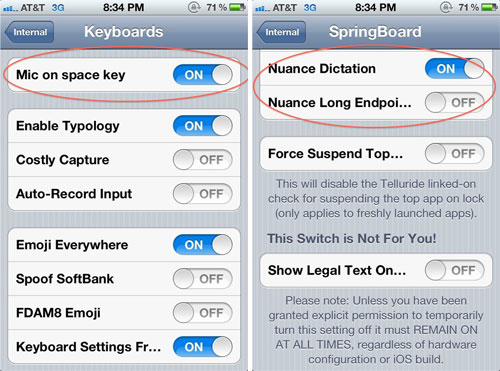
iOS Speech Recognition Settings Confirm Nuance-Apple Partnership
A couple of screenshots posted on Twitter by @ChronicWire reveals hidden Nuance preferences found in the latest internal iOS builds that confirms that Apple has been actively working on building in speech recognition into iOS.
Rumors of a Nuance-Apple partnership had been heavy in the weeks prior to WWDC, though no announcements were made during the keynote. Later, comments by Robert Scoble indicated that the deals were simply not completed in time for WWDC but were still in the works:
Saturday, June 11, 2011
Again: Nuance Slaps Vlingo With Another Patent Lawsuit Over Voice Recognition Technology
See below from Techcrunch: http://techcrunch.com/2011/06/09/nuance-sues-vlingo-again-over-voice-recognition-patents/#comments
Well, this is interesting. Nuance, a company that develops imaging and voice recognition technologies, is once again suing competitor Vlingo, which also develops a voice search technology and is backed by Yahoo, AT&T and Charles River Ventures.
According to the suit, which we’ve embedded below, Nuance claims Vlingo is infringing on number of Nuance’s patents including U.S. patent no. 6,487,534 B1, which relates to a “Distributed Client-Server Speech Recognition System.” By making, using, selling, offering to sell, and or importing its products and services related to speech recognition, Nuance says Vlingo is infringing on its patent.
Nuance is also claiming that Vlingo is infringing on that U.S. patent no. 6,785,653 B1, which is titled “Distributed Voice Web Architecture and Associated Components and Methods,” U.S. patent no. 6,839,669 B1, titled “Performing Actions Identified in Recognized Speech;” U.S. patent number No. 7,058,573 B1, titled “Speech Recognition System to Selectively Utilize Different Speech Recognition Techniques Over Multiple Speech Recognition Passes;” and U.S. patent no. 7,127,393 B2, titled “Dynamic Semantic Control of a Speech Recognition System.”
Nuance is requesting that Vlingo pay damages for infringing and profiting off the patents, but it’s unclear what the dollar amount of these damages are.
The two companies have a bit of a storied past. Nuance slapped Vlingo with a patent lawsuit back in 2008. Vlingo then bought a number of patents last year relating to voice and speech recognition, that aimed to force Nuance to drop its suit.
Dave Grannan, CEO of Vlingo, recently compared the act of competing with Nuance to
“having a venereal disease that’s in remission.” He tells Bloomberg BusinessWeek, “We crush them whenever we go head-to-head with them. But just when you’re thinking life is great – boom, there’s a sore on your lip.” Gross.
Nuance is a massive company with a $6 billion market cap and is a formidable competitor. In fact, Apple appears to be licensing Nuance’s technology in OS X Lion. And we heard that Nuance was in negotiations with Apple for a partnership to license and use the company’s voice recognition technology, though Nuance was missing from the lineup of products revealed this week’s WWDC conference. And we’ve learned that Apple may already be using Nuance technology in their new massive data center in North Carolina.
Photo Credit/Flickr/KWDesigns
Tuesday, January 11, 2011
The Search for a Clearer Voice - How Google's Voice Search is getting so good.
It raises again the issue of talking with the right (= US) accent to your phone.
The Search for a Clearer Voice
Smart phones are great at a lot of things, with one exception: Typing on a touch screen or a downsized keyboard is still frustrating compared to a full-size computer keyboard. That's probably why Google says that, even before the release of its new personalized Voice Search app for Android in mid-December, one in four mobile searches were already input by voice rather than from a keyboard.
The improved Voice Search takes speech recognition to its next level: Google's servers will now log up to two years of your voice commands in order to more precisely parse exactly what you're saying.
In tests on the new app, which appeared in Google's Android Market a week before Christmas, the app originally got about three out of five searches correct. After a few days, the ratio crept up to four out of five. It's surprisingly good at searches that involve common nouns ("heathen child lyrics") and what search experts call vertical searches for popular topics like airline flights and movie listings. Voice Search knows "United Flight 714" and "True Grit show times 90066" when it hears them. Less successful are searches involving people's names. In repeated attempts to Google up WikiLeaks founder Julian Assange, Voice Search got no closer than "wikileaks founder julian of songs."
How does it work? Rather than try to use the phone itself to do speech recognition, Voice Search digitizes the user's input commands and sends them off to Google's gargantuan server farms. There, the spoken words are broken down and compared both to statistical models of what words other people mean when they utter those syllables, plus a history of the user's own voice commands, through which Google refines its matching algorithm for that particular voice. The app recognizes five different flavors of English—American, British, Australian, Indian and South African—plus Afrikaans, Cantonese, Czech, Dutch, French, German, Italian, Japanese, Korean, Mandarin, Polish, Portugese, Russian, Spanish, Turkish, and Zulu.
The tricky part—and the motive for a personalized search app—is that human voices vary wildly between men and women, between young people and old people, and among those with various accents and dialects. By storing hundreds, perhaps thousands of what speech recognition experts call "utterances" by the same person over months of use, Voice Search can better guess at what that particular person is saying.
That mathematical model used to recognize phrases was refined over three years using voice samples from Google's now-defunct GOOG-411 automated directory assistance service, which the company operated from 2007 through late last year specifically to capture a wide-ranging set of voice samples for analysis. The company's first Voice Search app, for iPhone only, was launched a year after GOOG-411 in November 2008.
Voice Search doubles as a spoken-command system for the phone. As shown in this video, it understands commands such as, "Send mail to Mike LeBeau. How's life in New York treating you? The weather's beautiful here." The app will find LeBeau in your contacts—it's better at matching names here than in a Web search, because it's working with a limited set—and will fill in the subject line with your first sentence. You can speak additional text into the message, or edit it with the phone's keyboard, before sending it.
Google has clearly put a lot of effort into its speech recognition technology. But the impact on it bottom line is obvious: By removing the aggravation of typing on tiny keys, the company hopes to get customers to reach for its search and e-mail services much more often.
Saturday, September 25, 2010
New speech analysics whitepaper
http://images.tmcnet.com/tmc/whitepapers/documents/whitepapers/2010/3013-speech-analytics-simple-definition.pdf
Thursday, September 23, 2010
Nuance Launches Dragon Dictate for Mac -- Simply Smarter Speech Recognition
Dragon Speech Application for Mac OS X Taps New Dragon 11 Engine, Allows Mac Users to Create Content and Interact with Their Favorite Applications by Voice
BURLINGTON, Mass., Sep 20, 2010 (BUSINESS WIRE) -- Nuance Communications, Inc. (NUAN 14.88, -0.31, -2.04%) , a leading provider of speech solutions, today unveiled Dragon Dictate for Mac version 2.0, the newest addition to the Dragon family of speech recognition products which includes Dragon NaturallySpeaking for the PC and Dragon Mobile Apps. Dragon Dictate for Mac -- the first major desktop product for Mac OS X from the Dragon family following Nuance's acquisition of MacSpeech earlier this year -- makes it easier than ever to create documents and emails, search the web, navigate the Mac desktop, and interact with popular Mac applications -- all by voice.
Dragon Dictate for Mac, version 2.0, improves on the accuracy and performance of MacSpeech Dictate 1.5, leveraging the new Dragon 11 engine, which also powers the recently-announced Dragon NaturallySpeaking 11 for the PC. Dictate 2.0 offers a more streamlined set-up, revamped Mac user interface, and dynamic new voice commands for dictation, editing, navigation and proofreading. Dragon Dictate for Mac also "learns" better than any previous version of Dictate, responds faster to spoken commands and supports Dragon Voice Shortcuts(TM) for searching the web, email and Mac desktop by voice.
"Recognizing the important opportunity within the Mac community, we set out earlier this year to bring Dragon to the Mac, working closely with our experts from the MacSpeech team, and drawing on our history and proven success with Dragon," said Peter Mahoney, senior vice president and general manager for Dragon at Nuance. "We've maintained the elements of Dictate that are most important to our Mac customers, such as the native Mac interface, and integrated many features of Dragon NaturallySpeaking 11 to bring improved accuracy as well as smarter command and control capabilities to this discerning audience of new Dragon customers."
Dragon for PC, Mobile, and now the Mac
For years, people from all walks of life have used Dragon NaturallySpeaking on the PC to be more productive, save time and capture their ideas at the speed of thought -- at home, in the office, the courtroom, the classroom, the exam room, or even on the road. Most recently, with Nuance's Dragon Mobile Apps on the BlackBerry, Apple iPad, iPhone and iPod touch, millions of people now communicate quickly and easily on their mobile devices, simply using speech recognition. Dragon Dictate for Mac is the first Mac member of the Dragon desktop family, allowing Mac users to speak their minds to:
- Turn talk into text -- Dragon Dictate for Mac lets users simply speak to produce text. Speak thoughts and watch the words appear on screen, inside almost any Mac application -- up to three times faster than typing -- with an astounding recognition accuracy rate of up to 99 percent, right out of the box.
- Unlock creativity -- Transform ideas into text at the speed of thought with Dragon Dictate for Mac. Users can let their creativity flow from brain to voice to produce emails, blog posts, essays, and more.
- Work comfortably -- With Dragon Dictate for Mac, control the Mac in a relaxed, hands-free manner without being tethered to the keyboard. Instead of using a mouse, just speak commands to launch and control applications. Move the cursor or click anywhere on screen, simply by voice.
- Multi-task -- Dragon Dictate for Mac allows users to tell the Mac what to do, with commands like "Reply To This Message" or "Open Microsoft Word" or "Search Google for Italian restaurants" to work faster and smarter. In addition, it's easy to create custom voice commands that automate complex workflows on the Mac.
- Work your way -- Dragon Dictate for Mac can be customized with a personal vocabulary and voice commands that reflect an individual's work style.
In addition to the powerful voice commands that MacSpeech Dictate 1.5 already offers for controlling popular Mac applications such as Safari, Mail, iCal and iChat, the new Dragon Dictate for Mac 2.0 adds more ways to interact with the Mac by voice:
- Dragon Voice Shortcuts(TM) for Search -- Offers an easy way to search for information, files and content anywhere on your Mac or on the Web by using single voice commands. For example:
- "Search Google for hula dancing lessons"
- "Search Bing for wedding dress repair"
- "Search Yahoo for gondola rentals"
- "Search Mail for RSVP"
- "Search Mac for history term paper"
- New Editing Commands -- A new suite of commands in Dragon Dictate for Mac makes it easy to edit documents. With commands that are designed to simplify editing, users can select and delete text, insert new text, capitalize text, and more.
- Proofreading -- The new Proofreading commands in Dragon Dictate for Mac take advantage of the powerful Text-to-Speech capabilities built into Mac OS X. Simply dictate text, and ask Dragon Dictate for Mac to read it back.
- Surrounding Punctuation -- New commands in Dragon Dictate for Mac enable users to put punctuation around certain words or groups of words, using a simple command, such as:
- "Put Quotes Around "
- "Put Parentheses Around "
- "Put Brackets Around "
- Voice Navigation -- Dragon Dictate for Mac lets users control the Mac's cursor and mouse actions by voice, giving new options for interacting with their desktop and precise handling of mouse pointer-based tasks. New features include:
- MouseGrid: Placement of the cursor can be accomplished with MouseGrid commands
- Mouse Click: Speak a command, with optional that designate one or more keys such as Command, Option, Shift or Caps Lock
- Mouse Movement: New commands move the mouse pointer by voice
- Flexible Microphones -- Dragon Dictate for Mac users who have multiple microphones, such as a wired and wireless headset, can easily switch between microphones within the same voice profile.
Pricing, Availability & System Requirements
Dragon Dictate for Mac is available immediately starting at $199.99 through Nuance's Web site as well as its global network of reseller partners, software retailers and professional sales organizations. Existing MacSpeech Dictate customers and Dragon NaturallySpeaking customers can purchase Dragon Dictate for Mac starting at $49.99 and $99.99 respectively for a limited time. For additional information on features, editions, pricing and volume licensing programs, please visit www.nuance.com/dragon/mac.
Dragon Dictate for Mac requires an Intel-based Mac, Mac OS X 10.6 Snow Leopard or greater, 3GB of available hard drive space, 2GB of RAM recommended and an Internet connection for product registration. Dragon Dictate for Mac comes complete with a Nuance-approved USB microphone headset.
Trademark reference: Nuance, Dragon, Dragon Voice Shortcuts, Dragon Dictate, Dragon NaturallySpeaking, and the Nuance logo are registered trademarks or trademarks of Nuance Communications, Inc. or its affiliates in the United States and/or other countries. All other company names or product names referenced herein may be the property of their respective owners.
About Nuance Communications, Inc.
Nuance is a leading provider of speech, imaging and customer interaction solutions for businesses and consumers around the world. Its technologies, applications and services make the user experience more compelling by transforming the way people interact with information and how they create, share and use documents. Every day, millions of users and thousands of businesses experience Nuance's proven applications and professional services. For more information, please visit: www.nuance.com.
SOURCE: Nuance Communications, Inc.
Nuance Communications, Inc. Erica Hill, 781-565-5218 erica.hill@nuance.com Twitter : @DragonTweets, @macspeech http://www.facebook.com/dragonnaturallyspeakingor InkHouse for Nuance Communications, Inc. Lisa Mokaba, 781-791-4570 nuance@inkhouse.net
UTOPY Recommended by Ovum’s 2010 Contact Center Speech Analytics Market Report
UTOPY, the leading provider of Voice of the Customer and Performance Optimization solutions powered by Speech Analytics, announced that it has been recognized for its leadership in recording-system-independent Speech Analytics by Ovum’s 2010 contact center Speech Analytics market report.
Titled “Decision Matrix: Selecting a Speech Analytics Vendor,” the report examines the competitive dynamics within the Speech Analytics market in order to help businesses select a vendor based on its technology strength, reputation among customers and impact on the market.
In the report, an independent technology analyst provides a comprehensive view of vendor capabilities and advises on those that businesses should explore, consider and most importantly, shortlist. The report cited the advantages provided by UTOPY’s ability to integrate with virtually any call recording system. UTOPY also gained high marks for its core technology, interface and packaged applications, and earned additional praise for its support of a wide range of languages, dialects, and accents.
“We are pleased to receive this recommendation from Ovum,” said Roy Twersky, President and CEO at UTOPY. “We believe this further underscores UTOPY’s unwavering commitment to developing innovative, analytics-driven solutions that provide contact centers with unsurpassed insight into customer-agent conversations, which can be leveraged to maximize performance and profitability.”
Find more on Utopy at www.speechanalytics.com.
Saturday, May 8, 2010
Sunday, February 7, 2010
Yet another speech translation story - now from Google
http://technology.timesonline.co.uk/tol/news/tech_and_web/personal_tech/article7017831.ece
Google leaps language barrier with translator phone
GOOGLE is developing software for the first phone capable of translating foreign languages almost instantly — like the Babel Fish in The Hitchhiker’s Guide to the Galaxy.
By building on existing technologies in voice recognition and automatic translation, Google hopes to have a basic system ready within a couple of years. If it works, it could eventually transform communication among speakers of the world’s 6,000-plus languages.
The company has already created an automatic system for translating text on computers, which is being honed by scanning millions of multi-lingual websites and documents. So far it covers 52 languages, adding Haitian Creole last week.
Google also has a voice recognition system that enables phone users to conduct web searches by speaking commands into their phones rather than typing them in.
Now it is working on combining the two technologies to produce software capable of understanding a caller’s voice and translating it into a synthetic equivalent in a foreign language. Like a professional human interpreter, the phone would analyse “packages” of speech, listening to the speaker until it understands the full meaning of words and phrases, before attempting translation.
“We think speech-to-speech translation should be possible and work reasonably well in a few years’ time,” said Franz Och, Google’s head of translation services.
“Clearly, for it to work smoothly, you need a combination of high-accuracy machine translation and high-accuracy voice recognition, and that’s what we’re working on.
“If you look at the progress in machine translation and corresponding advances in voice recognition, there has been huge progress recently.”
Although automatic text translators are now reasonably effective, voice recognition has proved more challenging.
“Everyone has a different voice, accent and pitch,” said Och. “But recognition should be effective with mobile phones because by nature they are personal to you. The phone should get a feel for your voice from past voice search queries, for example.”
The translation software is likely to become more accurate the more it is used. And while some translation systems use crude rules based on the grammar of languages, Google is exploiting its vast database of websites and translated documents to improve the accuracy of its system.
“The more data we input, the better the quality,” said Och. There is no shortage of help. “There are a lot of language enthusiasts out there,” he said.
However, some experts believe the hurdles to live translation remain high. David Crystal, honorary professor of linguistics at Bangor University, said: “The problem with speech recognition is the variability in accents. No system at the moment can handle that properly.
“Maybe Google will be able to get there faster than everyone else, but I think it’s unlikely we’ll have a speech device in the next few years that could handle high-speed Glaswegian slang.
“The future, though, looks very interesting. If you have a Babel Fish, the need to learn foreign languages is removed.”
In the Hitchhiker’s Guide to the Galaxy, the small, yellow Babel Fish was capable of translating any language when placed in the ear. It sparked a bloody war because everyone became able to understand what other people were saying.
Sunday, September 20, 2009
Nuance and Lawsuits - again
In addition the the IBM engine which has strong patent behind it, Vlingo is leveraging new relations with AT&T as an investor and as a speech engine (Watson) provider in prep for the Nuance lawsuit. So now the IBM engine is licensed to Vlingo via Nuance (and this is why theuy are suing them). Moreover, Vlingo is not using this engine anymore. It seems like lawyers tricks rather than technology.
AT&T Backs Vlingo as Nuance Lawsuit Looms
AT&T has taken a minority stake in Vlingo in a move that could have major repercussions for Nuance’s patent infringement suit against the voice navigation startup. As part of the deal, Vlingo will integrate its offerings with AT&T’s Watson, a core speech recognition technology that serves as a foundation for voice-activated products. Vlingo will all but abandon the IBM-developed technology that it had been using — and which is at the heart of Nuance’s lawsuit.
“Our goal is to move everything to AT&T,” Vlingo CEO Dave Grannan told me this morning. “If Nuance decides to proceed, they’ll essentially be suing us for violating patents — and this is the crazy thing — and the alleged violation occurs in the IBM engine Nuance licensed to us and, by the way, we don’t use anymore.”
Nuance executives were not immediately available for comment.
Grannan said the Watson engine is “superior” to the IBM-developed technology and will help Vlingo build better voice navigation offerings. AT&T and Vlingo will begin rolling out new products later this year for AT&T customers and plan to market the joint solution to other industry players, including device manufacturers and other carriers.
The cutthroat nature of the speech recognition space underscores the increasing attention it’s attracting from investors, as voice is positioned as a superior navigation tool to device keypads and touchscreens -– especially for users behind the wheel. A Boston-area outfit, Vlingo began to gain traction in early 2008 when Yahoo tapped it to add a speech recognition component to its oneSearch offering. The agreement –- which followed Vlingo’s $6.5 million Series A round in 2007 -– saw Yahoo lead a second round of funding that brought in $20 million.
But Vlingo isn’t the only startup getting funded; the space has attracted hundreds of millions of dollars, and competition is fierce. Microsoft Corp. joined the field two years ago with its $800 million acquisition of Tellme, whose technology it’s using to incorporate speech into its upcoming Windows Mobile 6.5. Google has invested heavily as well, and is deploying voice navigation with its Android platform. As for the voice recognition companies themselves, outside of Vlingo, smaller players such as V-Enable and Promptu are also vying for attention. Meanwhile Nuance, the dominant pure play on the field, has spent $1 billion or so in acquisitions.
- By Colin Gibbs | Gigaom
Tuesday, July 14, 2009
Nuance acquires Jott (without suing them first :-)
If you know more, share with us this info.
Nuance Acquires Jott, Expands Mobile Portfolio
Innovative Jott Service to Deliver Powerful New Voice-to-Text Capabilities to Mobile Operators and En
BURLINGTON, Mass. & SEATTLE--(BUSINESS WIRE)--Nuance Communications, Inc. (NASDAQ: NUAN - News) today announced it has expanded its Mobile Division voice services portfolio with the acquisition of Jott. Jott is the innovator behind the popular Jott Assistant, the simple and easy-to-use service that enables users to create notes, set reminders and appointments, send email and text messages, and post to their favorite web services – all by voice, from any device.
“Jott’s voice-to-text offerings have experienced a groundswell of adoption and positive industry recognition since the company’s inception, and we’re thrilled about the opportunity to expand our market reach and our voice services portfolio,” said Michael Thompson, senior vice president and general manager, Nuance Mobile. “Together we will deliver a range of new services to our mobile operator and enterprise customers.”
The combined Nuance and Jott teams will focus on several key voice-to-text initiatives:
- The innovative Jott Assistant service has been adopted by hundreds of thousands of users, providing vast insight into the demands of today’s mobile users. To further extend the power of Jott across the mobile mass market, Nuance plans to package and offer Jott Assistant to mobile operators as part of its voice services portfolio, including Nuance Voicemail-to-Text.
- By combining its easy-to-use voice services with email, text messaging and a variety of web services, Jott’s service has advanced mobile productivity in the enterprise market. Nuance, together with its Enterprise Unified Communications partners, will offer a secure, highly scalable and differentiated Enterprise package including Nuance Voicemail-to-Text, Messaging, and Collaboration.
- As used in Jott for Salesforce, Jott provides open APIs that allow for voice integration with third party CRM providers and other critical enterprise applications that require mobile access. Nuance will continue to mainstream and expand the CRM partner program through its existing CRM partnerships, enabling enterprise application providers to better meet the needs of the evolving professional mobile market.
“We’ve seen dramatically increased demand for our mobile voice solutions, because they offer real business value, are easy to deploy, and are a delight to use,” said John Pollard, co-founder, Jott. “Nuance has consistently delivered groundbreaking mobile applications to billions of people worldwide. Our combined expertise will bring innovative and differentiated voice services to a variety of markets with tremendous scale.”
All of Jott’s services, including Jott Assistant, Jott Voicemail and Jott for Salesforce, will remain available, and existing customers will experience no interruptions in service. For more information and to access Jott services, visit www.jott.com.
About Nuance Communications, Inc.
Nuance is a leading provider of speech and imaging solutions for businesses and consumers around the world. Its technologies, applications and services make the user experience more compelling by transforming the way people interact with information and how they create, share and use documents. Every day, millions of users and thousands of businesses experience Nuance’s proven applications and professional services. For more information, please visit: Nuance.com.
About Jott
Headquartered in Seattle, WA, Jott Networks is the world leader in mobile voice-to-text applications. Jott allows individuals and businesses to easily capture thoughts, send emails and text messages, set reminders, organize lists, and post to web services and business applications – all with their voice, using any phone. Jott also converts voicemail into email and text messages, making voicemail a more productive tool. Since being founded in 2006 by John Pollard and Shree Madhavapeddi, Jott has made world-class voice transcription accessible to anyone with a cell phone. For more information on the Jott service, visit www.Jott.com.
Friday, July 3, 2009
Google voice mail transcription quality - can you trust it?
See information at pushing the limits of googles speech recognition and messing with googles speech recognition part 2.
To some extent everybody knows it is experimental and do not really trust it. Is it useful? Probably just for fun and for people who do not want any human to be involved in their private message transcription like SpinVox, Nuance or other such vendors.
Saturday, May 23, 2009
“Mainstream” Speech Analytics
For years we are pushing speech anlaytics to the market and the adoption cycle is pretty long and thus maybe expensive. It requires experts to learn the system and get th best out of it. Eventually there are many success stories for speech analytics. However for a technology to become widely use there is a need for additional simplicity - make sure it can be operated by laymen, work out of the box and provide benefits without much learning. This is exactly the step that Verint is taking with the new system and I bet it will overachieve any other offering in the market.
If you consider deploying a speech analytics solution, even for a small contact center - this should be your first alternative.
Verint Witness Actionable Solutions Takes Speech Analytics “Mainstream” with New Impact 360 Speech Analytics Solution
Breakthrough Technology Enables Cost-Effective Deployment of Speech Analytics, Helping Companies React Rapidly to Changes in Customer Behavior, Reduce Expenses and Enhance the Customer Experience
New Speech Analytics “Essentials” Solution Enables Small and Medium-Sized Contact Centers to Attain Speech Analytics Benefits Previously Out of Reach
LAS VEGAS & MELVILLE, N.Y.--(BUSINESS WIRE)--Verint® Systems Inc. today announced the availability of its new Impact 360® Speech Analytics solutions. Simple and cost effective to deploy, the software from Verint® Witness Actionable Solutions® is bringing speech analytics technology into mainstream contact center operations without costly setup overhead, lengthy consulting engagements and the need for interpretation by separate analyst staff.
The new Impact 360 Speech Analytics enables businesses to mine recorded customer interactions to surface the intelligence essential for building effective cost containment and customer service strategies. Designed to provide rapid insight into changes in customer behaviors and patterns, the solution can deliver value right out-of-the-box by helping remove guesswork from the customer service equation. Impact 360 Speech Analytics proactively identifies call drivers — along with the related product, process and service issues that often originate in areas outside the contact center, such as back-office functions — emerging trends, opportunities and competitive influences, and can then make that business intelligence available enterprise-wide.
The newly introduced Impact 360 Speech Analytics Essentials solution enables businesses with small to medium-sized contact centers to cost-effectively achieve these speech analytics benefits that were previously out of reach.
“We believe this is a technological breakthrough that has the potential to create a new wave of adoption for speech analytics, breaking down previous barriers to entry, such as set-up and configuration,” explains Nancy Treaster, senior vice president and general manager, Verint Witness Actionable Solutions. “We know that the contact center holds a wealth of valuable business intelligence, and speech analytics is an automated, powerful solution that can help companies not only get to that information, but then determine what actions to take. Impact 360 Speech Analytics Essentials allows organizations with small and medium-sized centers to analyze captured conversations and rapidly benefit from valuable insight.”
Robust, New Functionality Extends Verint Leadership in Analytics
The patent-protected Impact 360 Speech Analytics Essentials, and the Impact 360 Advanced Speech Analytics solution, leverage both phonetics and LVCSR recognition — the best combination of both speed and accuracy — adding meaning and context to every word and phrase identified in every call processed without predefinition of terms.
Key, patent-pending functionality featured in Impact 360 Speech Analytics Essentials, as well as Verint’s Impact 360 Advanced Speech Analytics solution, is driven by the company’s proprietary Complete Semantic Index™ technology that features such functionality as:
- Automated Trend Analysis, Surfacing Changes in Customer Behaviors
Using hundreds of thousands of term and phrase combinations, the new Complete Semantic Index automatically identifies significant changes in customer behavior as expressed within recorded customer interactions. Such changes are proactively surfaced by the software’s Automated Trend Analysis, which identifies increases or decreases in terms and phrases used during customer/agent conversations. Delivered daily, trend reports can be tracked for up to 18 months.
- Guided Search and Context Visualization
With the Complete Semantic Index, users do not need to know in advance what terms to search. Intuitive search engine-like, guided search capabilities — including contextual suggestions and search visualization functionality — help business users find relevant calls quickly to determine the underlying causes of rising call volumes, costs and customer dissatisfaction.
- Analytics-Driven Unification with Workforce Optimization Suite Via Native Integrations
The Impact 360 Speech Analytics solutions, part of Verint’s patent-protected, unified Impact 360 Workforce Optimization suite, can use the content of captured customer interactions to route contacts of interest to users throughout the enterprise, such as quality supervisors, marketing managers and customer retention teams.
“We’re excited to introduce this solution, as Verint is fulfilling a critical market need in enabling businesses with small and medium-sized centers to reap the same type of intelligence that their larger counterparts have used for years — all at an attractive price point, and at a time in our economy in which cost containment, retention and the customer experience are paramount,” adds Treaster.
Specifications and Availability
Optimally sized for centers with 50 to 300 agent seats, Impact 360 Speech Analytics Essentials can operate on a single box. As businesses’ needs change and grow, the solution can be easily upgraded to Verint’s advanced speech offering designed for larger centers, scaling up to 50,000 seats.
In addition to the new Complete Semantic Index, Automated Trend Analysis and Guided Search functionality, the Impact 360 Advanced Speech Analytics solution for larger center operations includes Automated Root Cause Analysis with patent-pending TellMeWhy™ functionality. With this capability, the solution can identify potential underlying drivers of specific call types, such as customer complaints or long calls, prioritize the top five root cause groups and automatically suggest the top instigators for each call set.
The Impact 360 Advanced Speech Analytics solution also features Speech Analytics-driven Scorecards designed to help centers better manage performance by balancing cost drivers with customer satisfaction drivers. Peer-based agent comparisons factor in key performance indicators (KPIs), such as customer complaints and repeat call drivers, that are identified from speech analytics results, along with proactive alerts on defined thresholds. Other functionality includes native business integrations with Impact 360 Quality Monitoring’s Smart Inbox™— which delivers recorded interactions directly to the desktop based on defined criteria that can include speech analytics categories — and Impact 360 Data Analytics, which analyzes call attributes to help uncover contact scenarios that can positively or negatively impact organization and/or individual KPI achievements.
About Verint Witness Actionable Solutions
Verint® Witness Actionable Solutions® is the leader in analytics-driven workforce optimization software and services. Its solutions are designed to help organizations capture customer intelligence, uncover business trends, discover the root cause of employee and customer behavior, and optimize the customer experience. From contact centers to remote office, branch and back-office operations, its award-winning, next-generation Impact 360® Workforce Optimization suite is the industry’s most unified solution set — featuring quality monitoring and recording, workforce management, speech analytics, data analytics, customer feedback surveys, performance management, eLearning and coaching. Impact 360 helps improve the entire customer service delivery network, powering the right decisions to help ensure service excellence and transform organizations into customer-centric enterprises.
About Verint Systems Inc.
Verint Systems Inc. (VRNT.PK), headquartered in Melville, New York, is a leading provider of Actionable Intelligence® solutions for an optimized enterprise and a safer world. Today, more than 10,000 organizations in over 150 countries rely on Verint solutions to perform more effectively, build competitive advantage and enhance the security of people, facilities and infrastructure. Visit us at our website www.verint.com.
This press release contains "forward-looking statements" within the meaning of the Private Securities Litigation Reform Act of 1995, including statements regarding expectations, predictions, views, opportunities, plans, strategies, beliefs, and statements of similar effect relating to Verint Systems Inc. These forward-looking statements are not guarantees of future performance and they are based on management's expectations that involve a number of risks and uncertainties, any of which could cause actual results to differ materially from those expressed in or implied by the forward-looking statements. For a detailed discussion of these risk factors, see the Company's Current Report on Form 8-K filed with the Securities and Exchange Commission on September 10, 2007, as supplemented by our Current Reports on Form 8-K filed on November 5, 2007, January 16, 2008, and April 9, 2008 and the Form NT-10Q filed on April 16, 2009. The forward-looking statements contained in this press release are made as of the date of this press release and, except as required by law, the Company assumes no obligation to update or revise them or to provide reasons why actual results may differ.
VERINT, the VERINT logo, ACTIONABLE INTELLIGENCE, POWERING ACTIONABLE INTELLIGENCE, WITNESS ACTIONABLE SOLUTIONS, STAR-GATE, RELIANT, VANTAGE, X-TRACT, NEXTIVA, ULTRA, AUDIOLOG, WITNESS, the WITNESS logo, IMPACT 360, the IMPACT 360 logo, IMPROVE EVERYTHING, EQUALITY, CONTACTSTORE, EYRETEL, BLUE PUMPKIN SOFTWARE, BLUE PUMPKIN, the BLUE PUMPKIN logo, EXAMETRIC and the EXAMETRIC logo, CLICK2STAFF, STAFFSMART, AMAE SOFTWARE and the AMAE logo are trademarks and registered trademarks of Verint Systems Inc. Other trademarks mentioned are the property of their respective owners.
Saturday, April 11, 2009
Google's 'Voice Search' comes to India
I specifically liked the example to search for whether :) - must be phonetic.. Anyway given the heavy accents of the south and north and various sub languages, there is a lot of work for google india for just collecting all this data.
Google's 'Voice Search' comes to India
The 'voice search' uses a combination of automated voice recognition engine and operators to provide this facility. To make the service faster and better, Google is also experimenting with voice recognition technology, which will ensure 24-hour support. Currently, the automated system offers results in English, but the operator-driven system offers results in only Hindi and Telegu.
"This is in line with our mission of making information universally useful and accessible, be it at home or on the go," explains Hugo Barra, Group Product Manager, Google Mobile. Not all those who make queries, though, will get accurate results, since the project is still in its pilot stage, reported Business Standard.
Google's logic is a simple one. Mobiles outnumber personal computers (PCs) in India. Besides, just about 5-7 percent of the population has an internet connection, including those who use surf the net via their mobiles. "Voice enables India to reach non-web users in local languages even as our core strength is search," Barra adds.
In the U.S., Western Europe and Japan, the 'voice search' feature is available under the Google Mobile App for the iPhone. It is also available on the Android-based T-Mobile G1, and was introduced on the BlackBerry as a free download last month.
In India, though, Google plans to extend the technology to other cities once it is confident in the quality of its speech recognition technology "in any region of the country", since the number of languages and accents in India are very diverse and distinct from each other.
The company is currently not making any revenue on this service in India though it monetises this in the U.S., Western Europe and Japan through ads which appear when the results show up. It does not charge the user for information received or for connecting them to businesses. The local business information used by Google is the same as that on local search. Data is continuously being added, and Google is collecting feedback from the users, Barra explained.
Talking about the company's mobile strategy, Vinay Goel, Country Head of Products, Google India, said, "There has been a significant increase of mobile search users in 2009. We believe that users graduate from plain voice search to an SMS-based one and finally to internet-based search, which is our goal."
The search giant has also made Orkut (its social networking site) and Google Maps available on mobiles. Besides, it also has the Google Latitude (to help locate one's friends) feature as an opt-in download.
Tuesday, March 31, 2009
Google Voice should hire Spinvox for message transcription
I guess it is the laymen feedback on the google voice service and exactly what I anticipated at:
Google Voice - the new threat to the reputation of speech recognition system.
Google Voice should hire Spinvox for message transcription
March 30th, 2009
I have been using GrandCentral for years and when they announced Google Voice I was elated. I could not wait for the new features including my absolute favorites being SMS and voice mail being transcribed to text and emailed and texted to you.
Well the SMS is great but the voice transcription is dreadful. I didn't call someone back last week mistakenly thinking it was a telemarketer. It was Bena Roberts of GoMoNews fame and a very important mover and shaker in the business. This kind of transcription mistake is not acceptable. I have a suggestion for Google Voice that I really hope they listen to, OUTSOURCE TO SPINVOX. Now I don't work for SpinVox, but I've used it and on dozens of friends very high regard and reference for the SpinVox service I'm willing to give this advice.
Google don't allow Google Voice to tarnish a perfectly fantastic service because you're not willing to spend a few dollars. Go test out SpinVox and if it beats your transcription (I guarantee it will) then please switch over.
TelStrat - TelStrat’s Engage™ Suite Now Understands Speech Analytics
Engage Analyze expands TelStrat's contact center product portfolio with true phonetic speech analytics intelligence
Orlando, Florida – March 30, 2009 – TelStrat, a global supplier of comprehensive contact center solutions, business call recording products, and leading-edge access network systems, today chose VoiceCon Orlando 2009 as the venue to announce Engage Analyze, the latest addition to its industry-leading contact center solution suite. Engage Analyze provides advanced speech analytics that equip organizations to transform voice calls into knowledge that can help them improve efficiency, increase compliance, and gain the competitive advantage.
Engage Analyze indexes and audio mines words and phrases buried in calls using a patented Phonetic Audio Search and Recognition Engine. Unlike older, less efficient speech-to-text approaches, phonetic speech search is not dependent on finite dictionary and grammar models which require constant maintenance. This makes it easy to accurately search for new competitors, product names, slang, and other dynamically changing terms.
Phonetic search technology also makes Engage Analyze fast – much faster than speech-to-text systems. Pre-processing or indexing of content is typically 60-80 times faster than real time, more than an order of magnitude faster than Large Vocabulary Conversational Speech Recognition (LVCSR) speech-to-text systems. Subsequent searches for words or phrases are incredibly quick, averaging over 30,000 times faster than real time and reaching rates up to 80,000 times faster.
Speech-to-text systems rely on limited, statistical sampling of calls, typically 3-5% of call volume, due to cost and complexity. The technology in Engage Analyze makes it possible to audio mine up to 100% of calls, in real time if desired. The product does all this without the massive computing power necessary for comparable LVCSR systems. With Engage Analyze, contact centers can now accurately analyze and recognize trends over thousands of hours of customer calls.
"With Engage Analyze we're bringing our customers advanced technology that provides them with a powerful tool to enhance business and customer intelligence, "said TelStrat President Kevin Smith. "The search speed and recognition capabilities make this product a market leader, and we've made it affordable for organizations of virtually any size."
Engage Analyze is the newest component of TelStrat's Engage Contact Center Suite. Engage Suite blends full-featured voice and screen recording; intuitive agent performance evaluation, tracking and coaching; powerful agent scripting and call automation; sophisticated workforce forecasting and scheduling; and now, advanced speech analytics. It addresses each major aspect of contact center operations. Designed to benefit any 'center of contact', Engage Suite is ideal whether used by a large telemarketing firm or a small company's support staff.
http://www.telstrat.com/content/view/399/350/
Monday, March 30, 2009
Salesforce.com speech recognition integration by Jott
Jott Networks Introduces Jott for Salesforce, Makes Mobile CRM Input Insanely Simple With Voice-to-text
SEATTLE, March 19 /PRNewswire/ -- Jott Networks today announced the addition of Jott for Salesforce to its expanding line of mobile productivity services. The new service uses Jott's high-quality voice-to-text technology, and allows sales professionals to make a simple call on any phone to directly input opportunity updates, take quick notes, and set reminders and appointments - all hands-free. Jott is offering a one-month free trial of Jott for Salesforce and it comes with a free subscription to Jott Assistant Pro, Jott's widely acclaimed mobile productivity tool.
Jott CEO and co-founder John Pollard said, "There are already over a thousand businesses that use Jott's other services to get more done on the go. These same businesses wanted us to provide integration with more critical business applications and Jott for Salesforce is the first in that line." He added, "Sales professionals can now use our best-in-class voice-to-text technology to avoid the hassle of cramped and clumsy mobile interfaces and frustratingly slow connection speeds. Sales teams spend more time selling and less time typing reports, and sales managers see greater adoption of Salesforce and receive better, fresher forecast data." Jott for Salesforce includes the following features:
Features for Sales Professionals
- Update opportunities and accounts - Use your voice to quickly update entire opportunities with a simple flow or individual forecast fields with shortcuts. Data ends up in specific accounts with no cutting, pasting or forwarding required.
- Take quick notes - While they are still fresh, speak quick notes about accounts and opportunities and add tasks to your Salesforce dashboard.
- Schedule appointments and set reminders - Use your voice to book a meeting on your Salesforce.com or Outlook calendar, and set reminders so you never forget.
- Get confirmation of everything - Every update you leave comes with a confirmation email/text message so you know for certain that data was entered into your accounts.
Features for Managers
- Set up in minutes - Jott for Salesforce is incredibly easy to set up. There are no desktop or phone downloads, and it requires no changes to your existing Salesforce set-up.
- Scale easily - Jott for Salesforce was built for scale. With nothing to download or maintain, and no new equipment to buy, it easily accommodates individuals or organization-wide rollouts.
- No training necessary - While training is available to help teams get the most out of Jott for Salesforce, only a few simple commands are needed to get started.
Pricing and Availability
Jott for Salesforce is available today from the App Exchange on Salesforce.com and from the Jott.com web site. It takes just a few minutes to set up, and is compatible with all carriers and all mobile phones in the US and Canada. Jott for Salesforce's pricing is straightforward and affordable at $25 per user per month. For that fee, users can send unlimited updates into Salesforce with no need to worry about overage charges.
For more information on Jott Salesforce and other Jott services, please visit www.Jott.com.